All great stories have always based their beginning in an aura of mystery that contributes to making their legend even greater, this affects the history behind many mechanical items such as cars, motorcycles, planes and even bicycles!
The legendary mechanical vehicle we want to talk about is the Bianchi R super is the model that most of all has made school of style and technical.
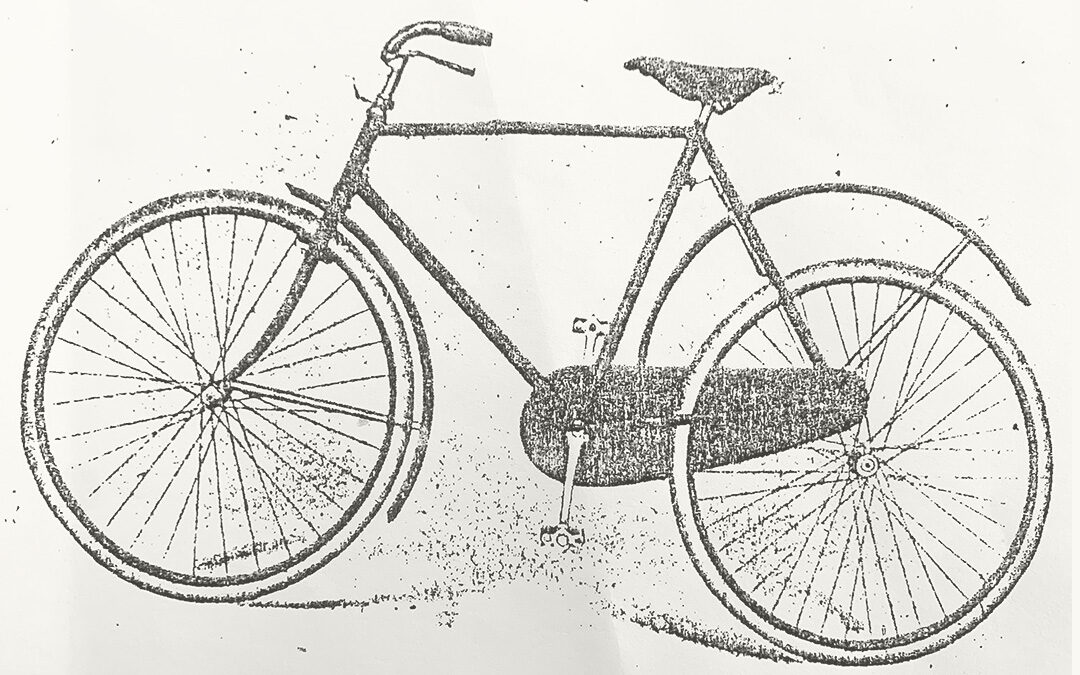
 Prima immagine inserita nell’articolo della rivista Auto – Moto – Ciclo: vista dal lato destro della nuova macchina prodotta da Bianchi.
The extraordinary nature of this article does not only concern the uniqueness of the velocipede but it is also affect the source and its relative dating.
If we ask any italian enthusiast-collector the first year of production of Bianchi R super, he would certainly reply angrily “but what an obvious question: 1924!” unfortunately this answer is the daughter of the main-stream to point out the cataloging of the vehicle as the first year of production and, in our opinion, this is a wrong practice, we will explain the reasons.
It was the year 1922 that Bianchi in addition to the R model, which for years represented the maximum avant-garde of touring bikes, had not innovated much the velocipedistica fleet but on the contrary had slightly degraded it with the marketing of the model. S-Bis with handlebar with external levers known more commonly by the name Bianchi Roller.
At this point we can only hypothesize, as we have no material to support this thesis, that the negative criticism made by customers and consequently by representatives against Bianchi was rather heavy; to update the fleet of bicycles on the market, Bianchi found himself forced to try his technicians into an exercise somehow unique regarding technique and style.
In fact, the following year (1923) the Bianchi model was presented at the Gran palais in Paris and at the Olympia in London: the “R special”, just like that and not “R super” as we have always thought, the technicians of the sector and the ‘public opinion are stunned, the goal is hit.
Thanks to a recent bibliographic discovery, we are proud to dust off and re-present, after 97 years, the source that describes the main characteristics of the spearhead of Bianchi production.
The writing on which we are based was published in the magazine “Auto – Moto – Ciclo” in December 1923 and below and we report it to you:
“A new jewel has emerged from the workshops in Viale Abruzzi (located in Milan) from which Bianchi launched its marvelous models around the world. The latest addition, a compendium of long efforts and studies, is the special “R” bicycle, an exquisite model that has aroused the admiration of technicians and the public at recent international exhibitions. At the Grand Palais in Paris, at the Olympia in London, this Bianchi bicycle raised the most unanimous praise, beating by far all the models on display. For some time Italy, thanks mainly to Bianchi who can be considered as the leader in the world, had achieved the primacy in the elegance of bicycle construction: this new bicycle, so simple, so finished, so perfect, is a new triumph for the industry. Italian foreign models, both in Paris and in London, did not stand up to comparison: England itself, once the undisputed master of cycling production, had to bow in admiration. The perfection achieved by the bicycle for some time now no longer gave rise to hopes of new improvements: at least that was the common opinion. Instead Bianchi, who was the first to build the best models, Bianchi who made the bicycle industry great in Italy and appreciated abroad, has found a way to create something new, beautiful and practical on the small steel horse. This is the result of faith, passion, love, with which one studies at the great Milanese house, the bicycle construction. Because the current prodigy is precisely the result of loving and patient studies, it is the result of the tireless desire to improve the small mechanical device more and more, to make it a true jewel of mechanics and elegance. The new improvements made to the Bianchi bicycle mainly concern the brakes and their transmissions and the disassembly of the rear wheel hub. The new brake arrangement, with invisible transmissions for both the front and rear, immediately give the car extreme simplicity and elegance, together with greater protection and robustness of the controls. Bianchi had already taken a good step, eliminating the external rods on the handlebars. But they immediately reappeared on the side of the steering tube and along the cross tube of the frame. “
 Prospetto frontale del manubrio e della forcella.
By external rods we believe we mean the external linkages that in the R model were included inside the handlebar.
“Even with an accurate construction like that of Bianchi, these rods were too noticeable with their levers, joints, etc. which could hinder the cleaning of the car or present a weak point in the transmission. both brake rods are instead completely enclosed within the frame tubes, in the “R” Speciale model. “
 Focus sulla parte anteriore della Bianchi “R – speciale”.
Now the article gives a detailed description of the operation of the internal brakes:
“The front brake is operated by a small lever located under the knob: the tie rod passes inside the handlebar at the middle of which it finds a joint, from which the other tie rod that controls the branch with the two pads starts, which acts under the fork head. The result is a simple, solid and invisible assembly. The rear brake is also operated by a lever on the handlebar and by tie rods that act inside the steering head. At the lower end of the steerer, the tie rod activates a circular ring inserted on the crown of the fork. This transmits the movement to a fork lever, from which an other tie rod starts that runs through the inside of the transverse tube. At the intersection of the pedal board another joint is applied from which the tie rod continues right up to the saddle. Here the movement comes out into the open and activates the rear brake branch, which acts with two pads above the wheel rim. A spiral spring placed at this last lever recalls the brake command. The whole assembly is very simple and ingeniously constructed: the dinghy can turn completely around itself without finding an obstacle in the joints of the tie rods, which is not the case in ordinary bicycles.”
The special R was exhibited with the removable pin version, in fact the second part of the mechanical description includes the hub:
 Prospetto e sezione del mozzo filabile posteriore.
“The rear hub system is also very simple and useful. In today’s luxury bicycles with chain guards, removing the rear wheel to repair the tire, for example, or to replace a spoke was an improbable undertaking. It was even necessary to remove the chain guard, which, once removed, can hardly be replaced properly. To overcome this inconvenient, Bianchi has equipped its latest type, with a rear hub that can be removed by loosening the safety nut.
 Profilo del lato sinistro della Bianchi “R – speciale” all’atto dello sfilmetno del cerchio posteriore.
Once the pin is removed, the wheel comes out of the fork while the pinion and chain remain attached to it. There is therefore no need to make any adjustments to the wheel or to pull the chain, since this remains in its fixed place on the sprocket of the free wheel. The assembly is extremely simple and practically very solid. The movable hub cones are replaced by two ball bearings, thus preventing the balls from falling when the pin is pulled out. The pinion is mounted on a male and female coupling sprocket: another male and female coupling sprocket is mounted on the adjusting crown fixed in the hub. The two couplings have mating surfaces and therefore remain fixed under pressure. Just remove the hub nut and loosen the pressure to be able to free the two clutches and remove the wheel, leaving the chain and the wheel pinion still in place, which remain inside the casing. “
And now the final words that praise the great work carried out in the Bianchi house:
“With these practical new devices, the construction of the bicycle takes a significant step towards greater simplicity, better aesthetics, greater ease of disassembly. Simply with the abolition of the external brake rods, the special Bianchi “R” acquires an exquisite line of extremely elegant simplicity, which makes the whole machine even more harmonious and sober. With the application of the removable hub on the rear wheel, the machine has an incomparable practicality for the removal of this wheel, with an enormous advantage for the speed and comfort of the system. With these two new applications, admired and appreciated by French and English technicians and by all the public who came to the redeemed exhibition of ANCMA, the white “R” -speciale can well be defined as the queen of bicycles “
The words we have quoted praise with patriotic and proud tones a mechanical and engineering effort that had never been attempted before the construction of the “R – special” and reflect the greatness and avant-garde of our nation’s industrial production in the world of bicycles in the 20s.